Organic click-through rate on queries with a Google AI Overview fell from 1.76% to 0.61% between June 2024 and September 2025, a 61% drop, according to Seer Interactive’s analysis of 3,119 informational search terms across 42 client organisations. US organic search traffic was down 2.5% year-on-year by January 2026 (Graphite data). The change is not theoretical. It is already in your analytics.
The uncomfortable bit: ranking number one no longer guarantees a click. If the AI summarises the answer, the user reads, nods, and leaves. So the new question is not “how do I rank” but “how do I get cited inside the answer”. That is generative engine optimisation, or GEO, and most of what is being sold under that name is recycled SEO advice.
This guide cuts through it. You will get the five tactics Princeton researchers actually tested and proved (some lift citations by 40%), the four still being flogged that do nothing, where AI engines look outside your site, and a 30-day plan you can run yourself.
Why the old SEO playbook stopped working
Two stats explain the shift.
First, ChatGPT now drives 87.4% of all AI referral traffic according to Lantern’s February 2026 attribution data, with the rest split across Perplexity, Gemini, Claude and Copilot. Not 40%. Eighty-seven. If you are not in ChatGPT’s answers, you are missing the channel.
Second, the visitors AI sends convert 4.4 times higher than standard organic search visitors on average (Lantern’s category figure, with meaningful variation by industry; B2B SaaS sees bigger lifts, e-commerce tends to see lower revenue per session). They arrive pre-qualified because the AI already vouched for you. They are not browsing. They are checking.
Put those together and you get a brutal trade. Organic clicks are shrinking but the clicks that do come are worth multiples of what they were. The brands quietly winning right now are the ones earning the citation, not the ones still chasing the blue link.
There is one more thing worth saying. Gemini’s referral traffic grew 388% year-on-year between September and November 2025 (Lantern data again). ChatGPT’s grew 1% in the same window. ChatGPT is the dominant engine today; it will not be the only one that matters by year end.
What AI engines actually do when they cite you
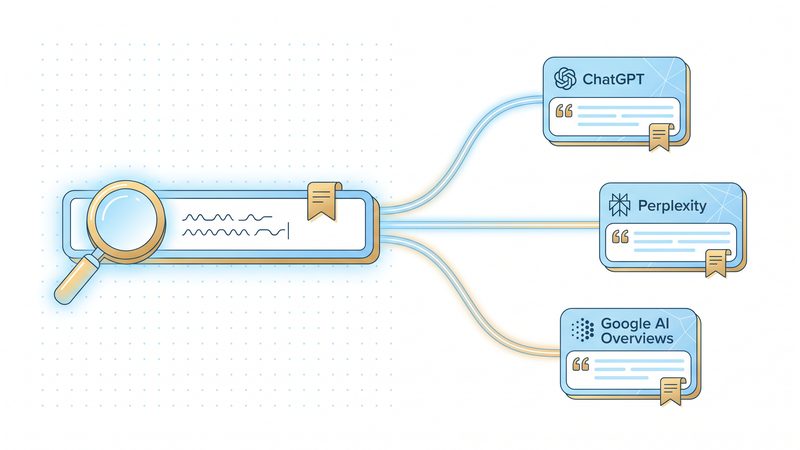
Strip the marketing copy and the process has three steps.
Retrieve. The engine fans the user’s question out into several sub-queries and pulls candidate pages, partly from a search index, partly from its training data, partly from a curated set of high-trust domains.
Rerank. Those candidates get scored on credibility, specificity, freshness and how cleanly the content can be lifted out as a claim.
Synthesise. The model writes the answer, dropping in citations from the surviving sources.
The interesting bit for SEO veterans: AI engines evaluate at the claim level, not the domain level. Google rewards accumulated link equity. AI engines reward whether the specific sentence on the specific page contains a verifiable fact in a citable shape. A scrappy page on a small domain can beat a polished page on a huge one if the sentence-level signals are stronger. That is the whole game.
The five GEO moves Princeton proved actually work
In August 2024, researchers from Princeton, IIT Delhi and a couple of independent collaborators published GEO: Generative Engine Optimization at KDD 2024. They tested nine content tweaks across 10,000 queries on a system designed to mimic Bing Chat, then validated the strongest tactics on Perplexity. It is still the only large-scale academic study of AI citation, and almost no GEO agency has actually read it.
Five tactics moved the needle. The top three lifted Position-Adjusted Word Count by 30 to 40 percent and Subjective Impression by 15 to 30 percent. Here they are, in order of impact.
Lift in AI citation visibility per tactic, measured across 10,000 queries
Source: Aggarwal et al., GEO: Generative Engine Optimization, KDD 2024 (arXiv:2311.09735). Top three percentages refer to Position-Adjusted Word Count.
1. Cite your sources
When you make a factual claim, link to the original. Not your own product page. Not a competitor’s blog. The primary source.
Princeton reported a 30 to 40% lift in Position-Adjusted Word Count for content with proper citations. The buried finding: lower-ranked sites benefited far more. Sites ranked fifth in Google search saw a 115% visibility lift from this single change. Top-ranked sites saw a slight decrease. Read that twice.
The mechanism is simple. AI models trust content that itself trusts something verifiable. Citations are a credibility signal at the claim level.
How to apply it: rewrite vague claims with named sources and a year. Not “AI search is growing fast” but “ChatGPT users send around 2.5 billion prompts per day, per OpenAI figures reported by TechCrunch in July 2025”. Specific. Sourced. Cite-shaped.
2. Add direct quotations from named experts
Insert quotes from named people with named titles at named organisations. The format matters. “According to [name], [title] at [organisation], ’…’” gets weighted as third-party validation.
Princeton found a 30 to 40% lift across the test set, with the strongest effect on explanatory and historical queries. The mechanism is the same as citations: the quote inherits credibility from the named source, and your surrounding content inherits credibility from the quote.
A British plumber I worked with last quarter went from zero AI citations to three within six weeks just by adding two quotes per service page from named trade-body experts. Same site. Same authority. New surface area for AI to grab.
3. Add specific statistics with named sources
Replace vague claims with numbers. A sentence with a figure is structurally easier to lift than a sentence without one.
Princeton’s data showed 30 to 40% improvement, biggest in fact-driven and policy-adjacent queries. The format that wins is the combination: statistic + named source + year. Any one of the three on its own is much weaker.
So not “many small businesses use AI for marketing”. Instead: “44% of ChatGPT citations come from the first third of a page, per Search Engine Land’s February 2026 analysis of 18,012 citations”. Three citable units in one sentence: a specific figure, a named source, a year.
4. Fluency optimisation (with one big caveat)
Rewrite for flow and clarity without changing the underlying claims. Princeton recorded a smaller but positive lift on this one. AI models are biased toward content that reads well because their training data over-represents well-edited writing.
The caveat is real, though. Generic AI-polished prose loses on a different axis. If your fluent rewrite ends up sounding like every other LLM-drafted page, the synthesis layer collapses it into a composite answer and credits nobody. The fix is to write fluently and keep your distinctive vocabulary, opinions, examples, and voice. Smooth, not bland.
5. Authoritative voice
Drop the hedging. Phrases like “it might arguably be the case that perhaps” signal low confidence to the model and lower extraction priority. State the claim or remove it.
Princeton’s lift was smaller than the top three and concentrated in interpretive content. The simple rule: if you can cite it, state it directly. If you cannot cite it, soften it or cut it. Hedging without evidence is a tell.
The tactics still being sold that do nothing
Same paper, several flops. Worth knowing because most agency proposals lead with at least one of them.
Keyword stuffing. Zero benefit, and a slight negative effect on Perplexity validation. The cleanest finding in the paper. Traditional keyword density does not transfer to AI citation.
Unique words. Cramming in low-frequency or rare terms hoping to look distinctive flopped too. The paper logged it as non-performing alongside keyword stuffing.
A couple of other moves often dressed up as GEO tactics fall flat in practice. Padding the word count without adding claims does nothing because AI models extract sentences, not page lengths. Hype copy without evidence (“the most innovative platform of 2026”) gets ignored at synthesis because the model has nothing to extract and attribute. The pattern across all the non-performers is the same: they add volume or vibes without adding cite-shaped substance.
If your current SEO retainer is built around any of these, you are paying for a 2018 playbook.
Where AI engines look outside your website
Here is the bit nobody wants to hear if they have spent a decade building owned media.
Peec AI analysed 30 million sources across ChatGPT, Google AI Mode, Gemini, Perplexity and AI Overviews in March 2026. The five most-cited domains across the board: Reddit, YouTube, LinkedIn, Wikipedia, Forbes. Yelp and G2 dominated recommendation queries. Engines diverged on emphasis. ChatGPT favoured Wikipedia, Reddit and editorial sites like Forbes. Perplexity leaned Reddit, LinkedIn, and G2 for B2B questions. Google AI Mode pulled disproportionately from Facebook and Yelp.
Top-cited external domains across ChatGPT, Gemini, Perplexity and AI Overviews
Source: Peec AI, analysis of 30 million citations across ChatGPT, Google AI Mode, Gemini, Perplexity and AI Overviews (March 2026). Yelp and G2 also rank highly on recommendation and B2B queries respectively. Bar lengths are illustrative of rank, not raw citation counts.
What this means in practice: 60 to 70% of the citation universe sits on platforms you do not control. You can write the best on-domain page in your category and still get scooped by a Reddit thread where someone described your product better than your own copy does.
The fix is not to abandon your site. The fix is to extend the entity. Concretely:
- A populated G2 or Capterra profile (B2B), or a Yelp/Google Business profile (local), with recent reviews containing the language buyers actually use.
- A Wikipedia entity if you qualify under notability rules. Most small businesses don’t, but a citation in a Wikipedia article you don’t own often does the job.
- An honest Reddit presence in two or three relevant subs. Not pasting promo. Answering questions in your area of expertise with genuine help. Six months of that and your brand shows up in AI answers because real users mentioned you.
- LinkedIn posts and articles from named team members. The platform shows up in 30 to 40% of B2B citations in Peec’s data.
This is slower work than tweaking a meta description. It is also the bit competitors haven’t done.
Format matters more than most people think
Lantern’s February 2026 citation data found a structural split that should change your content priorities.
ChatGPT cites product pages at 20.1%. Perplexity cites them at 0.4%. Fifty times the rate. Comparison content sits around 10.3% on ChatGPT. Listicles dominate Perplexity. FAQs do well across the board.
So if you only invest in blog content because that’s what every SEO post says to do, you are well-tuned for the engine that drives 12.6% of AI traffic and badly tuned for the one that drives 87.4%.
A few specific structural moves that compound with the Princeton five:
- Front-load the answer. Search Engine Land’s analysis showed 44% of ChatGPT citations come from the first third of the page. State the claim in the first 150 words. Bury the SEO-padded preamble.
- Add FAQ blocks to product, service and pricing pages with the questions buyers actually ask, written as standalone extractable answers.
- Build comparison pages targeting specific contexts: “X vs Y for a 10-person team”, not “best tools 2026”.
- Write product page copy that defines the product as a citable claim in one paragraph: what it does, who it’s for, what outcome it delivers. Marketing fluff doesn’t extract.
The technical bits worth bothering with
Three live debates, honest read on each.
Schema markup. Worth doing. FAQ schema, Organization schema, Product schema. AI engines use structured data to pre-extract answers, and several 2025 studies showed a meaningful citation lift on pages with schema versus pages without. Boring, mechanical, no shortcut.
llms.txt. The newer “robots file for AI” proposal. Otterly.AI ran a real-world experiment in late 2025 and the data was mixed. Some sites saw modest crawler engagement, most saw nothing measurable. ChatGPT and Anthropic haven’t publicly committed to honouring it. My take: add it if you can do so in 15 minutes, ignore it if it would take a week. The juice is not yet there.
JavaScript-rendered content. Most AI crawlers, including ChatGPT’s, do not execute JavaScript. If your key content only renders client-side, it might as well not exist for citation purposes. Server-side render the parts you want cited. This one is mechanical and binary.
Your 30-day GEO action plan
Stop reading. Open a tab. Do this.
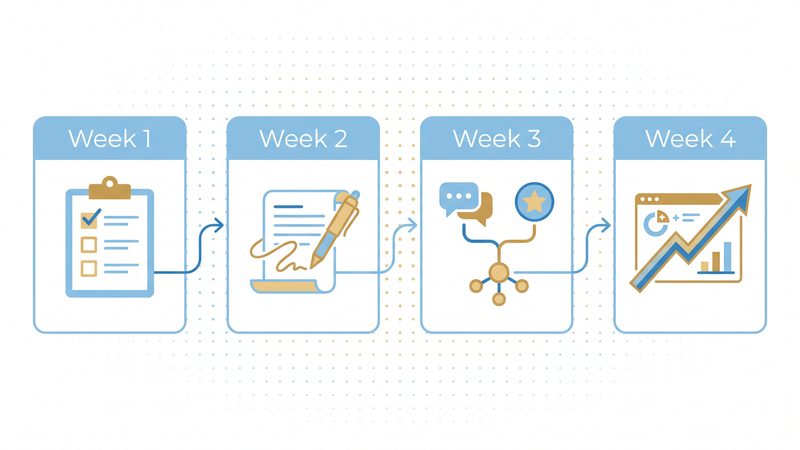
Week 1: audit. Pick your top 5 pages by traffic. For each page count three things: inline citations to external sources, named expert quotes, and specific statistics with named sources. Score each page out of 15 (5 per category). Anything under 10 has substantial upside. Do the same audit on your three closest competitors and note the gap.
Week 2: rewrite. Take the two pages with the biggest opportunity. Replace vague claims with the statistic + source + year pattern. Add one or two named-expert quotes. Front-load the answer in the first 150 words. Tighten any hedging you find.
Week 3: external work. Build or refresh your G2/Capterra/Yelp profile (whichever fits). Post one substantive Reddit answer in a relevant sub. Publish a LinkedIn post from a named team member sharing one specific finding from your week-2 rewrite, with a stat and a link.
Week 4: test. Run your 10 most important buyer-intent prompts in ChatGPT, Perplexity and Gemini. Note what gets cited. Track the gap between where you are and where you want to be. Pick the next two pages and start again.
Two extra moves that pay off over months, not weeks: set up a custom channel group in GA4 to track AI referral traffic properly (most of it currently logs as direct), and start publishing original data (a survey, a benchmark, a calculator) so you become the citable source other people quote.
For more on the SEO foundations this rests on, the essential SEO strategies guide on this site covers the basics. And if you want the broader picture of where this is all heading, Reddit Is Eating Search covers why community forums now sit at the top of so many AI answers.
The small-brand window
Here is the contrarian bit. Generative engine optimisation is the cheapest competitive opening small brands have had in over a decade.
Traditional SEO favoured the incumbents. Backlinks, domain authority, accumulated trust signals. If your competitor had a ten-year head start, you were probably stuck. AI engines evaluate at the claim level, which collapses that moat. The Princeton paper showed it explicitly: small sites gained 115% from citations alone. Large sites gained nothing.
The window will not stay open. Once the playbook is mainstream and every big brand has rebuilt their content around the Princeton five, the advantage normalises and the link-equity moat returns in a new shape. The companies who move in the next 6 to 12 months will compound the gain. The ones who wait will not.
So pick your five pages, do the audit, and book the four weeks. The bit that bothers me most about most GEO content right now is how complicated it pretends to be. It is not complicated. It is unfamiliar.
Right faff to set up. Worth it.
Want help running this on your own site? Get in touch or read more about how I work on the about page.